
Our Cleaning System: How Wake Tidy Delivers Consistent Results
When you hire a commercial cleaning company, you're trusting someone else to look after a part of your business that your customers and employees experience every day.
You expect the floors to be cleaned, the washrooms maintained, the garbage removed, and the details taken care of. You also expect those things to happen consistently, without having to inspect the building yourself every morning.
That sounds reasonable. Yet for many business owners and managers, cleaning becomes one more thing they have to manage.
A washroom gets missed. Paper products aren't restocked. Grease builds up around equipment. The cleaning company is contacted, the problem gets fixed, and a few weeks later the same issue comes back.
We believe there's a better way to manage commercial cleaning.
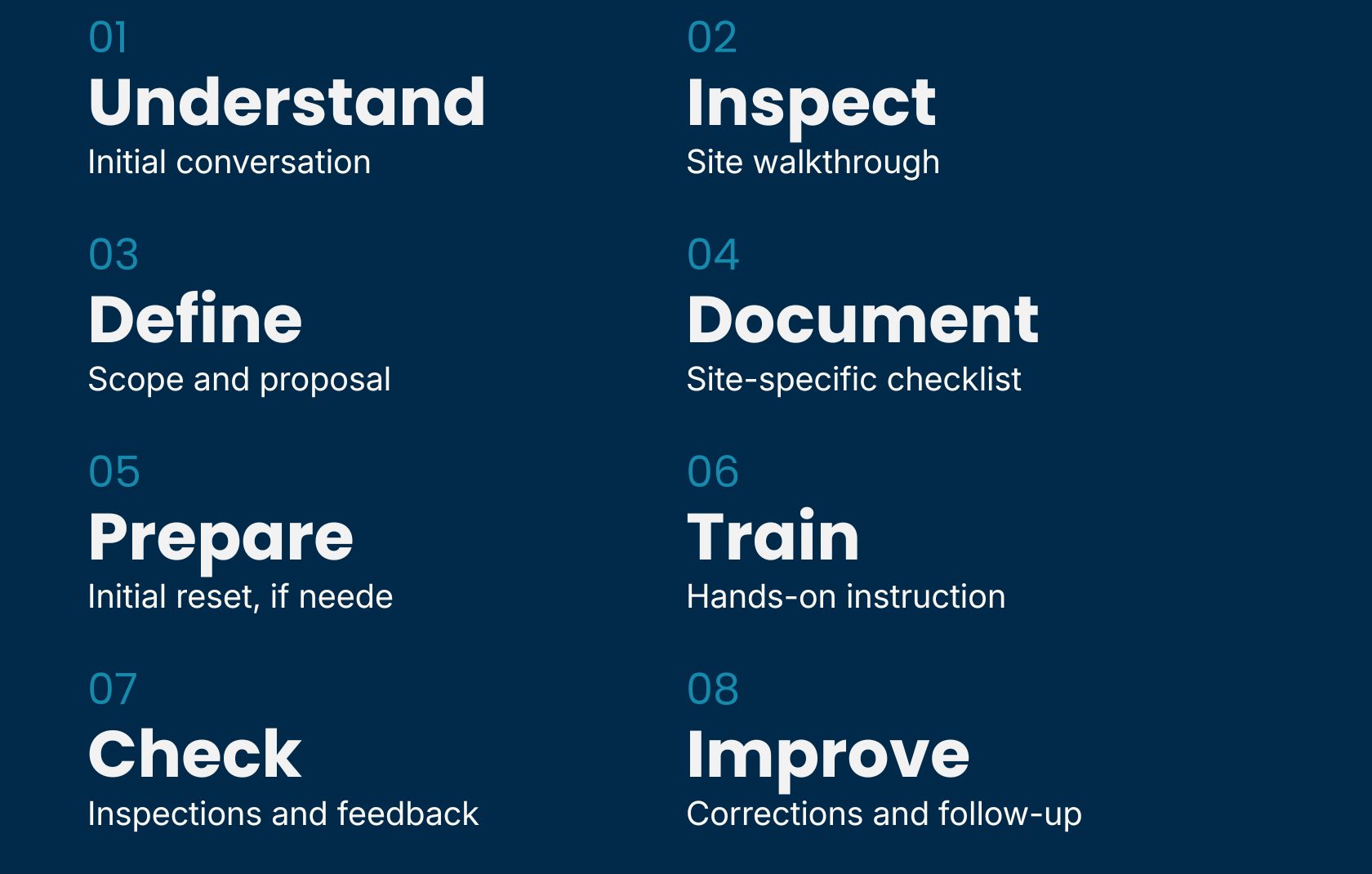
At Wake Tidy, our approach begins with understanding your building, documenting the work that needs to be done, training people to a defined standard, inspecting the results, and using feedback to make improvements.
Here's how that process works, from our first conversation through to the ongoing management of your cleaning service.
Why a Good Cleaning System Matters
There's an important difference between hiring someone to clean your building and hiring a company that has a process for managing the cleaning.
A cleaner can work hard, have years of experience, and genuinely care about doing a good job. But without clear expectations, proper training, and follow-up, the results can still vary from one shift to the next.
Consider a restaurant.
A chef doesn't simply tell a new employee to make a dish and assume they'll prepare it exactly the way the restaurant expects. There's a recipe, a method, training, and someone responsible for checking the finished product.
Cleaning should work much the same way.
The building has its own requirements. Certain areas need attention every service, while others need scheduled weekly or monthly work. The cleaning team needs to understand those expectations, and management needs a way to confirm they're being met.
That's the thinking behind the Wake Tidy cleaning system.
The goal isn't to make cleaning complicated. It's to establish a repeatable process that makes the results more consistent and gives business owners fewer things to worry about.
Step 1: We Start by Understanding Your Business
Before recommending a cleaning program or putting together a proposal, we want to understand how your business operates.
A high-volume restaurant has different cleaning requirements from a professional office. A nightclub with busy weekend service presents different challenges from a medical office or retail location.
Even two restaurants of similar size can need very different cleaning programs.
Our first conversation is about understanding the property, your schedule, and what you're trying to accomplish.
Some of the questions we ask include:
- How is your cleaning currently being handled?
- How often does the building need service?
- Are there recurring problems with your current cleaning arrangement?
- Which areas require the most attention?
- What are your expectations for daily, weekly, and periodic cleaning?
- Are there specific tasks you want taken off your employees' plates?
- When would you ideally want a new cleaning service to begin?
If you already have a cleaning company, we also want to understand what's working.
We might ask:
"If you could change one thing about your current cleaning service, what would it be?"
That one question often tells us a great deal.
Perhaps the cleaning itself is reasonably good, but communication is difficult. Maybe the daily cleaning is getting done, but the detailed work never happens. Or perhaps the service varies depending on which employee is working.
We want to understand those issues before developing a cleaning plan.
The goal of our first conversation
By the end of this discussion, we should have a clearer picture of your expectations, your operating requirements, and the problems you don't want to experience again.
That gives us a starting point for the next step: seeing the building for ourselves.

Step 2: We Walk Through Your Property
A site walkthrough is one of the most important parts of developing a commercial cleaning program.
It's an opportunity to understand the building beyond its square footage.
We look at how the space is used, the materials and surfaces that need cleaning, the amount of traffic moving through different areas, and the work required to maintain the property at an appropriate standard.
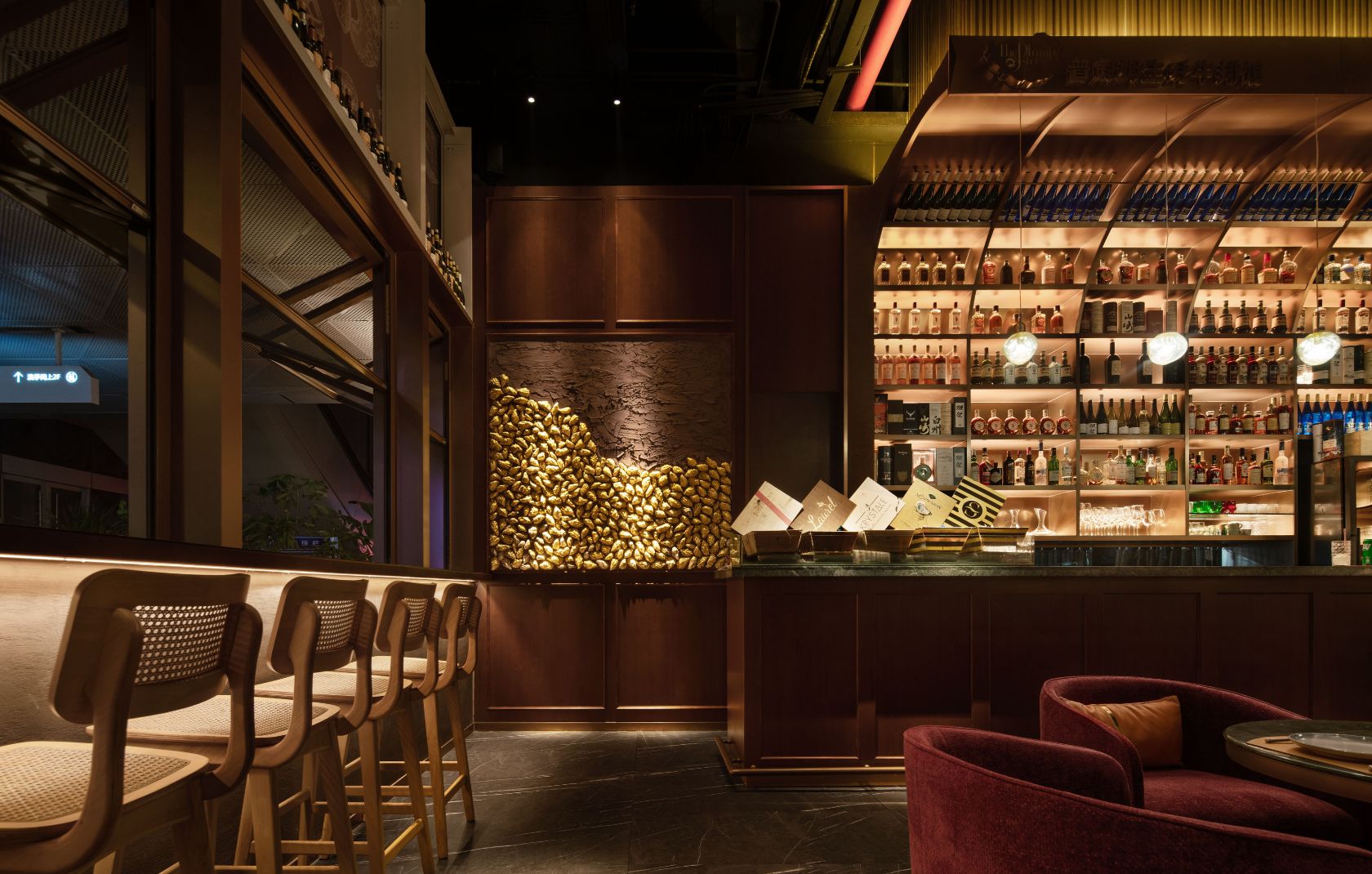
For a restaurant, that could include the dining room, entrance, washrooms, bar, kitchen floors, staff areas, and other spaces included in the proposed cleaning scope.
For an office, the focus may be on workstations, common areas, meeting rooms, washrooms, kitchens, entrances, and flooring.
What we're looking for during a walkthrough
Floors and surfaces
We identify the types of flooring, their condition, and the cleaning methods that may be appropriate.
Carpet, tile, concrete, and other surfaces don't necessarily require the same equipment or maintenance schedule.
Traffic and daily use
A busy restaurant entrance or heavily used washroom requires a different level of attention than a low-traffic storage room.
The amount of activity in a building helps determine the cleaning frequency and workload.
Existing cleaning challenges
We pay attention to areas where dirt, grease, debris, or odours may have accumulated.
These observations help us understand whether the building needs an initial detailed clean, recurring maintenance, or additional specialty services.
Access and operating hours
Cleaning needs to work around your business.
We discuss when our team can enter the property, which areas are accessible, how the building is secured, and any specific operating restrictions.
Supplies and equipment
We determine whether the cleaning arrangement needs to include consumables such as paper towels, toilet paper, hand soap, or garbage liners.
We also assess what equipment and cleaning methods are appropriate for the space.
Looking beyond the obvious
One of the things we've learned from years of restaurant cleaning experience is that some of the most important details aren't immediately visible.
An entrance can appear clean until you lift the floor mat and find gravel underneath.
A dining room can look presentable until the tables are rearranged and the carpet underneath reveals accumulated debris.
A garbage can may have a fresh liner while the container itself has residue and odour.
These details matter because customers and employees experience the entire environment, not just the most visible surfaces.
Our walkthrough helps identify those areas so they can be considered when developing the scope of work.

Step 3: We Develop a Cleaning Plan for Your Property
Once we understand your building and expectations, we can determine what cleaning should be performed, how frequently it should happen, and what resources are needed.
We don't believe every business should receive the same generic checklist.
A smaller professional office might need service several times a week, while a busy restaurant could require cleaning nearly every night.
Even within the same building, some tasks need attention every service and others are better handled periodically.
Daily or per-service cleaning
These are the recurring tasks typically covered by a janitorial services program, designed to keep the building maintained between operating days.
Depending on the property and agreed scope, this may include:
- Vacuuming and mopping designated floors
- Cleaning washrooms and fixtures
- Emptying garbage and cleaning receptacles as required
- Maintaining entrance and guest-facing areas
- Cleaning agreed common areas
- Restocking designated paper products and supplies
- Cleaning designated staff areas
For hospitality clients, the scope may also address particular areas that require regular attention due to food debris, grease, spills, and customer traffic.
Weekly cleaning and detail work
Some tasks don't require attention every night but should still be scheduled.
Examples could include more detailed cleaning around furniture, fixtures, edges, and other areas that need additional attention beyond the regular service.
The frequency depends on the property and the agreed cleaning program.
Monthly and periodic cleaning
Other areas may benefit from more detailed maintenance on a monthly or periodic schedule.
Examples include high dusting, de-cobwebbing, and additional floor or surface maintenance.
Specialty work such as pressure washing, window cleaning, carpet cleaning, kitchen equipment cleaning, and more extensive floor care can also be considered.
These services may be included in a broader program or quoted separately, depending on your requirements.
Why defining the frequency matters
One of the most common sources of frustration in a cleaning relationship is the difference between what the customer believes is included and what the cleaning company actually agreed to perform.
For example, a restaurant manager might assume the cleaning company moves dining room furniture every week.
The cleaning company might consider that work outside its regular scope.
Without a written agreement, the expectations are unclear.
Our goal is to remove as much of that uncertainty as possible before service begins.
Step 4: We Put the Cleaning Scope in Writing
After evaluating the property, we prepare a cleaning proposal that explains what we're recommending.
Rather than providing a price without much detail, the proposal should clearly describe the work, frequency, expectations, and relevant service terms.
You should never have to wonder what's included in your cleaning agreement.
A well-defined scope helps everyone involved.
You understand what you're paying for.
Our cleaning technicians understand what needs to be completed.
Our management team has a documented standard against which the work can be inspected.
What a cleaning proposal should include
Depending on the property, the written proposal outlines:
- The areas included in the service
- Tasks performed each service
- Weekly cleaning and detail tasks
- Monthly or periodic tasks
- Required service frequency
- Responsibilities for supplies and consumables
- Any additional or specialty services
- Relevant expectations, exclusions, and service terms
If a certain service isn't included, that should be clear too.
We would rather have that conversation before service begins than discover later that we had different expectations.
A cleaning scope is also a management tool
A written scope isn't simply a document that gets signed and filed away.
It becomes the foundation for training, checklists, inspections, and future conversations about the cleaning program.
When someone asks whether an area should have been cleaned, we should be able to refer to the agreed scope rather than rely on memory.
That brings us to the next part of the system.
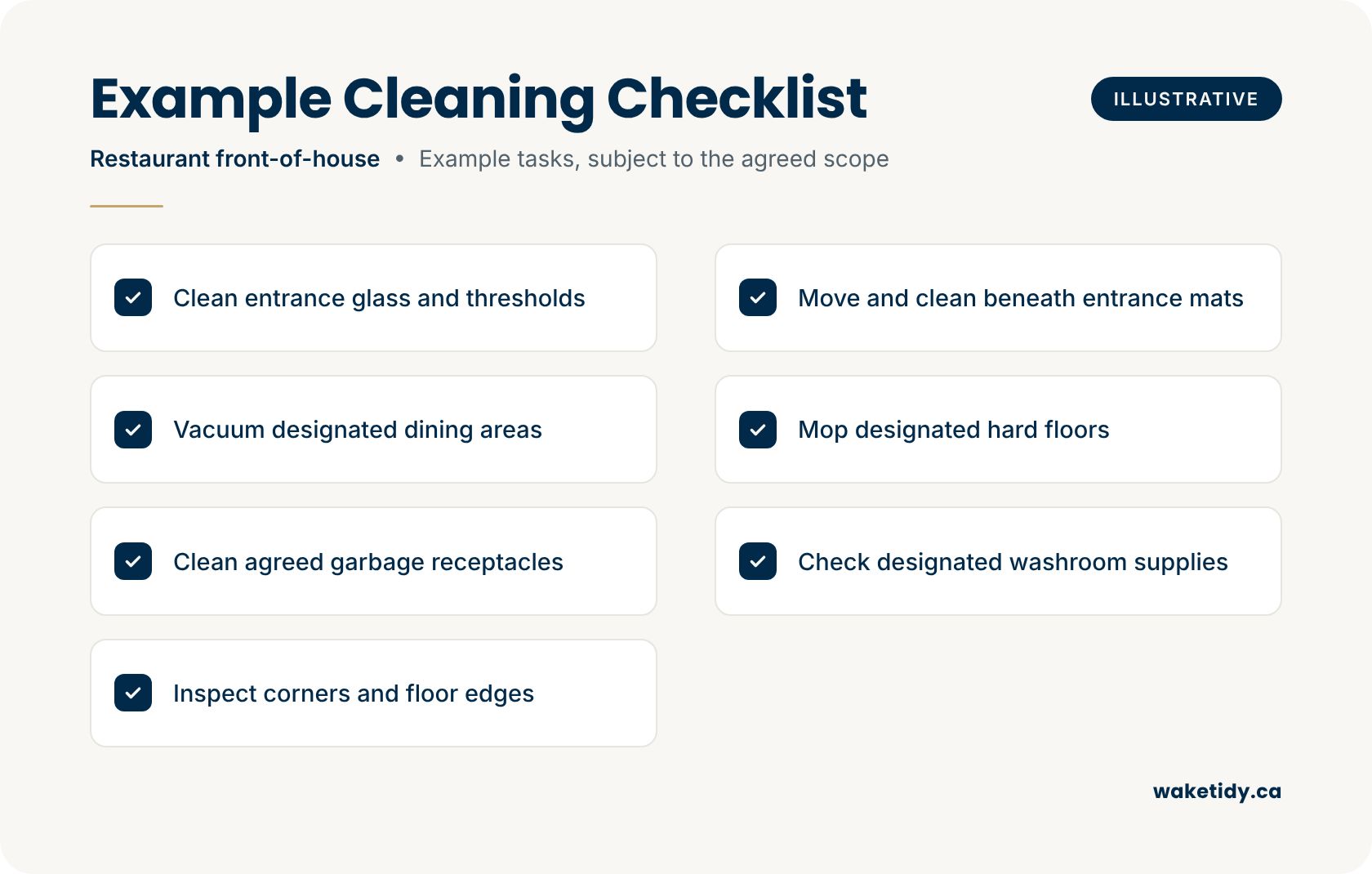
Step 5: We Turn the Scope Into a Cleaning Checklist
Once the work has been defined, it needs to be translated into clear instructions for the people performing it.
That's where the cleaning checklist comes in.
A checklist should reflect the actual property and its agreed cleaning requirements.
A restaurant with a large dining room, multiple washrooms, a bar, and staff facilities needs a different checklist from a small professional office.
The checklist should identify the tasks and areas covered by the service so the cleaning technician has a clear reference during the shift.
Why a checklist makes a difference
Imagine two cleaning technicians working at the same restaurant on different nights.
Both may be experienced, but they may have different opinions about which tasks deserve the most attention.
One might focus heavily on the floors.
The other might spend additional time detailing fixtures and furniture.
Without a consistent process, both employees could work hard and still produce different results.
A site-specific checklist gives them a common standard.
It also provides a useful reference for supervisors when reviewing the work.
Documenting the work
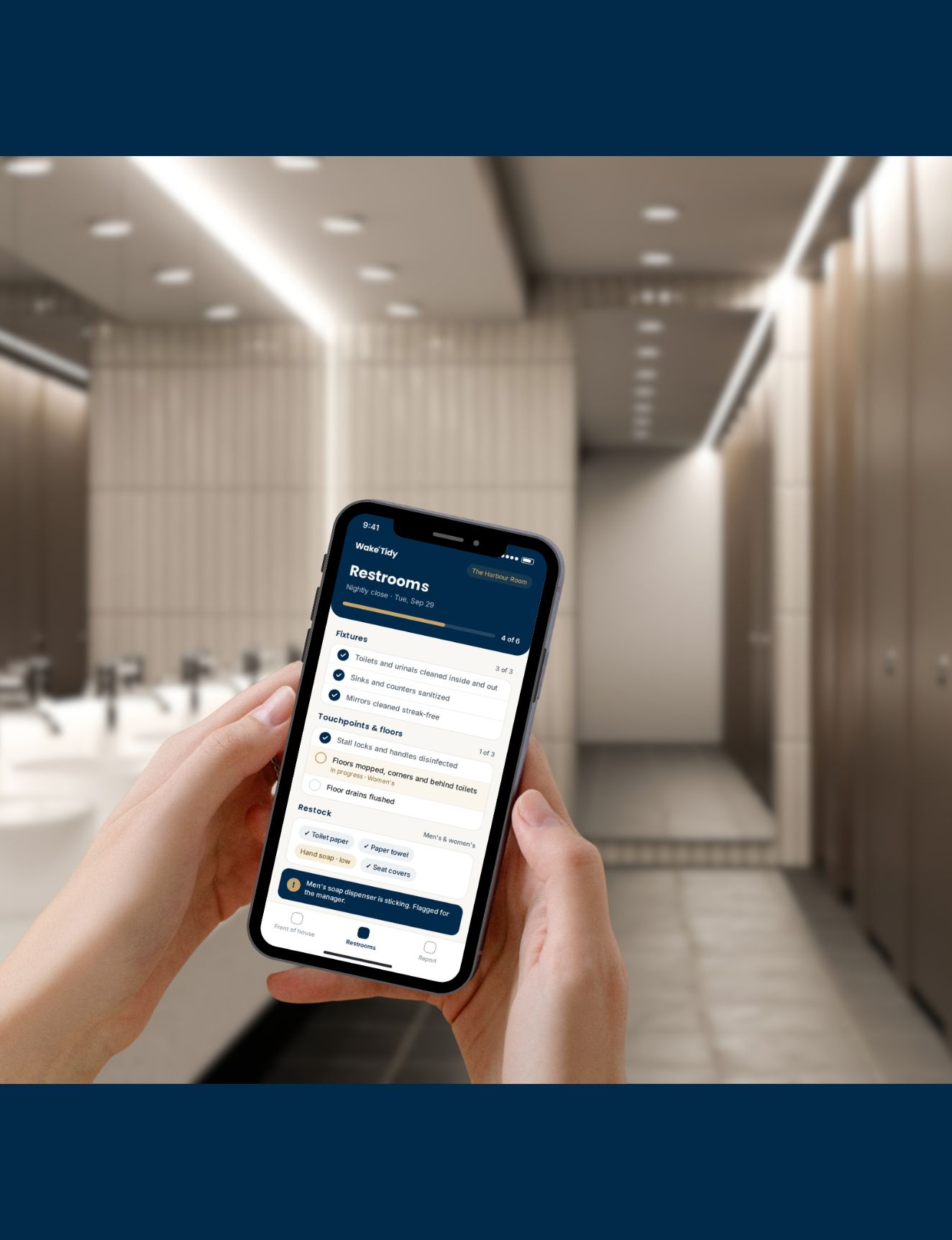
Wake Tidy's operating approach includes the use of site-specific cleaning checklists, with printed references where appropriate and digital reporting tools as our systems develop.
Digital reporting can help management review completed tasks, supporting photographs, and issues identified by the team.
But the technology itself isn't the most important part.
The important part is having a clearly defined standard that the cleaning team understands and that management can check.
A checklist doesn't replace good judgment or training. It supports them.
Step 6: We Establish the Cleaning Standard Before Settling Into Routine Service
When we take over a property, we first need to understand its starting condition.
Some buildings have been maintained consistently and are already close to the agreed standard.
Others may have areas where detail cleaning has been neglected over time.
For example, there may be grease buildup around kitchen equipment, dust on high surfaces, heavily soiled floors, or restroom details that have been repeatedly overlooked.
If those issues exist, regular maintenance alone may not be enough to address them.
Bringing the building up to standard
Depending on what we find during the walkthrough, we may recommend an initial detailed cleaning to bring the agreed areas to an appropriate starting condition.
That work could involve:
- Detailed floor scrubbing
- High dusting and cobweb removal
- Washroom detailing
- Additional attention to corners, edges, and hard-to-reach areas
- Cleaning accumulated buildup around suitable fixtures or equipment
- Other services identified during the walkthrough
The exact work would be discussed and scoped before it begins.
An initial reset isn't necessarily required at every property. But where significant buildup exists, addressing it at the beginning can make the ongoing maintenance program more effective.
After all, it's difficult to maintain a standard that hasn't been established yet.
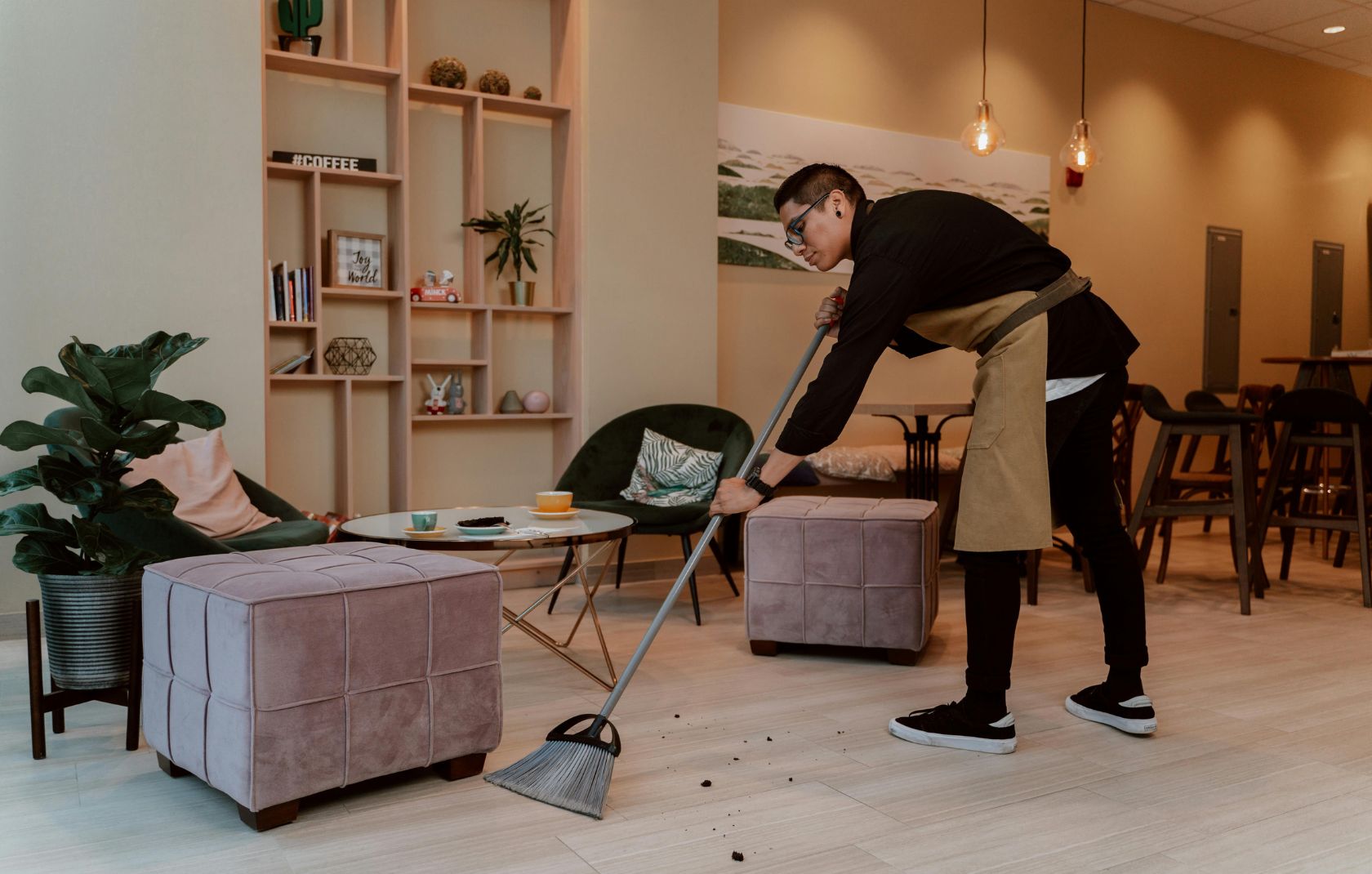
Step 7: We Train Our Team on Your Specific Building
We believe experience is valuable, but experience alone doesn't mean a cleaning technician knows how we want a particular property maintained.
Someone may have cleaned commercial buildings for years and still be unfamiliar with the surfaces, equipment, operating requirements, and expectations at your location.
That's why account-specific training matters.
Our approach is to teach the cleaning technician how the work should be completed in the building they're responsible for maintaining.
What account-specific training covers
Depending on the property, training can include:
Understanding the scope
The technician needs to know which areas are included, what tasks are required, and how frequently they must be completed.
Learning the building
This includes entrances, exits, supply storage, washrooms, equipment locations, access requirements, and specific trouble areas.
Using the right methods
Different floors, fixtures, and surfaces require appropriate cleaning methods, equipment, and products.
Following the cleaning sequence
A logical cleaning sequence helps technicians organize the work and avoid unnecessary duplication.
Learning the details
The team should understand which areas require particular attention, including corners, edges, fixture undersides, floor mats, and other commonly overlooked places.
Understanding the client's expectations
Cleaning technicians should know what matters to the customer, including concerns identified during the initial walkthrough.
Demonstration matters more than simply giving instructions
Handing someone a checklist isn't the same as training them.
Our training philosophy emphasizes demonstrating the task, giving the technician an opportunity to perform it, inspecting the result, and providing additional coaching when necessary.
A person isn't fully trained simply because they've been shown a process once.
The goal is for the technician to understand the expected result and demonstrate that they can achieve it consistently.
Training doesn't stop after the first shift
Buildings change. Employees change. Expectations can evolve.
If inspections or client feedback reveal that something isn't being completed properly, that becomes an opportunity to coach the team and reinforce the correct standard.
Continuous improvement depends on being willing to revisit the training rather than assuming the original instructions were enough.

Step 8: We Inspect the Cleaning, Not Just the Checklist
A completed checklist is useful, but it doesn't automatically tell us whether the cleaning met the expected standard.
That's why inspections are an important part of our approach.
The purpose of an inspection is to evaluate the actual condition of the building, identify anything that needs attention, and confirm that the cleaning program is working as intended.
We believe an effective inspection should consider three things:
How the building looks, how it smells, and how it feels.
That may sound simple, but each one can reveal something different about the cleaning.
What we look for during an inspection
Entrances and guest-facing areas
We look at entrance glass, thresholds, visible debris, floor edges, mats, and the general presentation of the space.
A clean entrance makes an impression before a customer even reaches the main part of the building.
Dining rooms and common areas
We inspect corners, furniture bases, accessible areas beneath tables and chairs, garbage receptacles, and other details within the agreed scope.
We also look for dust and debris that may have been missed during regular cleaning.
Restrooms
Washrooms deserve particular attention because cleanliness affects the experience of customers and employees. Our restroom sanitization services focus on the fixtures, surfaces, and details that require proper cleaning and maintenance.
An inspection may include toilets, urinals, sinks, faucets, partitions, floor edges, drains, vents, paper supplies, and odours.
A restroom can look clean at first glance while still having neglected areas.
Bars and service areas
For restaurant and hospitality clients, we pay attention to suitable surfaces, sinks, wells, floor areas, and places where spills or organic residue can accumulate.
The scope determines which areas Wake Tidy is responsible for maintaining.
Commercial kitchens
Kitchen inspections may consider floors, visible grease accumulation, accessible equipment surfaces, and any deep-cleaning tasks included in the service.
In some cases, these observations may lead to a recommendation for additional scheduled cleaning.
Inspections should be proactive
One of the biggest problems with some cleaning arrangements is that management only gets involved after a customer complains.
We don't believe that's a good way to manage quality.
The purpose of proactive inspections is to identify problems before the customer has to raise them.
Depending on the account and operating requirements, inspections may take place while cleaning is underway, near completion, or after the cleaning team has left.
Reviewing the work at different points helps management understand whether the expected process and results are being maintained.
The goal isn't to catch people making mistakes
An inspection is also a training opportunity.
If a technician has missed an area, we want to understand why.
Was the task overlooked? Was the checklist unclear? Was the employee properly trained? Was there an equipment issue? Did something unusual happen during the shift?
Understanding the cause helps us decide how to correct it.
Step 9: We Ask for Feedback Instead of Waiting for Complaints
There is an assumption in the cleaning industry that can cause problems:
If nobody complains, everything must be going well.
Sometimes that's true.
Other times, a customer has raised the same issue so many times that they've stopped bothering.
Silence doesn't necessarily mean satisfaction.
That's why client feedback is an important part of the Wake Tidy approach.
Feedback is especially important when a new account begins
During the early stages of a cleaning relationship, we want to understand how the service is performing from the customer's perspective.
Our account-launch approach places particular emphasis on seeking feedback throughout the first 30 to 60 days.
Some useful questions include:
- How has the cleaning been so far?
- Has your staff noticed anything that needs attention?
- Are there areas you feel could be better maintained?
- Is the service meeting your expectations?
- Is there anything we should be doing differently?
This information helps us identify gaps between the written scope, the way the work is being performed, and the customer's actual experience.
Different clients prefer different levels of communication
Some business owners appreciate regular phone calls.
Others prefer an occasional walkthrough or a quick email when something needs attention.
We want communication to be useful rather than another administrative task for the customer.
The important thing is that there's an established way to raise concerns, share observations, and stay connected.
We don't want our involvement to end once the agreement is signed.
Step 10: When Something Gets Missed, We Address It
No matter how much training, planning, or inspection goes into a cleaning program, people can still make mistakes.
We don't believe it's realistic to promise that every task will be completed perfectly every single time.
What matters is how a cleaning company responds when something isn't right.
Ignoring the issue, becoming defensive, or repeatedly offering an apology without making a lasting correction doesn't solve the problem.
Our approach is to understand what happened, address the issue, reinforce the standard, and follow up.
First, we acknowledge the concern
When a customer identifies a legitimate issue, we want to understand it and take responsibility for addressing it.
That means listening to the concern rather than immediately finding a reason to explain it away.
Next, we find out what happened
We speak with the cleaning team and review the circumstances.
There may have been an unusual situation, a misunderstanding about the scope, a training gap, or a task that was simply missed.
The cause matters because it helps determine the right response.
Then, we correct the issue
The next step is arranging an appropriate correction.
For routine issues, that may involve addressing the task during the next scheduled service. Certain circumstances may require a more immediate response, depending on the nature of the problem and the service arrangement.
We reinforce the standard
If the problem points to a training issue, the technician may need additional instruction or hands-on coaching.
If the checklist is unclear, it may need to be revised.
If the scope doesn't reflect the building's needs, that may require a conversation with the customer.
The goal is to address the underlying reason the issue occurred.
Finally, we inspect and follow up
Correcting a missed task once doesn't necessarily mean the problem has been solved.
We want to check the area again during subsequent inspections and confirm that the improvement holds.
We also want to follow through with the customer.
Accountability isn't pretending mistakes never happen. It's taking appropriate action when they do and making sure the same issue doesn't become a recurring frustration.
Step 11: We Keep Looking for Ways to Maintain the Building Better
A cleaning program shouldn't become something that nobody reviews once the original scope is agreed upon.
Buildings are used differently over time.
Customer traffic can increase. New equipment may be installed. Flooring can wear. A restaurant might change its dining room layout or adjust its operating hours.
Some maintenance needs also develop gradually.
That means periodic review is an important part of keeping a commercial space properly maintained.
Looking ahead instead of waiting for buildup
During inspections and visits, we want to identify developing issues that may benefit from scheduled attention.
For example:
- Dust accumulating on vents, ledges, and high surfaces
- Floors showing signs that more detailed cleaning is needed
- Grease building up around commercial kitchen equipment
- Exterior entrances collecting dirt or residue
- Carpet areas requiring periodic maintenance
- Bar or restroom areas that would benefit from more frequent detailing
Not all of these tasks are necessarily included in the regular cleaning agreement.
But identifying them gives the customer an opportunity to plan maintenance before conditions deteriorate further.
One relationship for more of your cleaning needs
Wake Tidy's service model is designed to support both recurring commercial cleaning and a range of specialty cleaning needs.
Depending on the property, those services may include floor care, window cleaning, pressure washing, high dusting, kitchen equipment cleaning, and other periodic work.
Some specialty services may be provided directly, while others can be coordinated through qualified service partners.
The benefit for the customer is having a primary point of contact who understands the property and can help coordinate appropriate work.
For busy restaurant owners and commercial property managers, that can mean spending less time dealing with separate cleaning vendors.
What This Means for Your Business
There's a reason we put so much emphasis on the process behind the cleaning.
Your business shouldn't depend on whether one particular cleaning technician happens to be working that night.
You shouldn't have to remember which areas need detailing, repeatedly remind a contractor to complete agreed tasks, or inspect every washroom and entrance yourself before opening.
A properly managed cleaning relationship should have clear expectations, trained people, a defined method of checking the work, and a process for addressing problems.
Learn more about Wake Tidy and the experience behind our approach to commercial cleaning.
Our goal is straightforward: take cleaning off your plate so you can focus on running your business.
Frequently Asked Questions About Our Cleaning Process
Do you provide the same cleaning checklist for every business?
No. Our approach is to develop a site-specific cleaning scope based on the building, its use, the required service frequency, and the customer's expectations.
A restaurant, office, and commercial property may all need different cleaning schedules and procedures.
Do you inspect the cleaning after every service?
Our quality-control approach includes proactive inspections, but the inspection schedule and method depend on the account and service arrangement. We don't promise that a supervisor will physically inspect every cleaning shift.
The goal is to use inspections, defined standards, training, and client feedback to maintain consistent results.
What happens if we're unhappy with part of the cleaning?
We want to know about it. Our approach is to understand the concern, review the circumstances, arrange an appropriate correction, provide additional coaching when needed, and follow up to confirm the problem has been addressed.
Can you help us determine how often our building needs to be cleaned?
Yes. That's part of the initial conversation and site walkthrough.
We consider the building's size, surfaces, customer traffic, operating schedule, current condition, and the level of cleaning you're looking for before recommending a service frequency.
Can specialty cleaning be included in our program?
Depending on your requirements, specialty services can be proposed as part of a broader cleaning arrangement or handled separately.
These may include floor care, pressure washing, window cleaning, kitchen equipment cleaning, and other scheduled maintenance tasks. Availability and how the work is delivered depend on the specific service.
What if our cleaning needs change over time?
We can review the cleaning scope and discuss changes to the service frequency, tasks, or specialty work as your business evolves.
Documenting the scope from the beginning makes those conversations easier because everyone knows what the existing agreement includes.