

Commercial Carpet Cleaning in Kelowna: Methods, Costs & What to Expect
Some commercial carpets have seen better days.
Restaurant dining rooms with dark walkways between the tables. Office carpets that look noticeably darker near the entrances. Strata hallways where years of foot traffic have left visible paths down the middle.
You vacuum regularly. You clean up spills. But eventually, those high-traffic areas start looking tired no matter how often someone goes over them with a vacuum.
The good news? Your carpets might not be as far gone as you think.
Professional commercial carpet cleaning can remove a surprising amount of accumulated dirt and soil. With the right cleaning method, equipment, and preparation, even heavily used carpets can sometimes look dramatically better.
At Wake Tidy, we provide commercial carpet cleaning in Kelowna for restaurants, offices, hotels, strata properties, and other commercial spaces.
In this guide, we'll cover how commercial carpet cleaning works, what it costs, how often it should be done, the differences between cleaning methods, and what to look for before deciding whether your carpets need cleaning or replacing.
A Simple Way to See How Dirty Your Carpets Really Are

Here's something worth trying the next time you're walking through your business.
Move a piece of furniture that hasn't been moved in a while.
It could be a restaurant table, a filing cabinet, a reception chair, or a piece of furniture in a hotel lounge.
Take a look at the carpet underneath it, then compare that area with the surrounding floor.
Notice a difference?
The carpet underneath might still have its original colour, while the exposed area has slowly become darker from dirt, spills, and foot traffic.
This is particularly noticeable in restaurant dining rooms, where tables and chairs often stay in roughly the same positions for years.
It's easy to get used to the gradual change because you see the carpet every day. But once you move the furniture, the contrast can be hard to miss.
That difference gives you an idea of what professional cleaning might be able to improve.
Of course, not every carpet can be restored to its original appearance. Permanent staining, fading, damaged fibres, and physical wear won't simply disappear with cleaning.
But if much of the colour difference comes from accumulated soil, there may be a worthwhile improvement waiting underneath.
Before spending money replacing commercial carpet, it can be worth having a professional assess its condition and, where appropriate, test-clean a small area.
Why Commercial Carpets Get Dirty So Quickly
Commercial carpets deal with conditions that most residential carpets never experience.
Think about how many shoes pass through the entrance of a busy restaurant, office building, or hotel every day.
Every person can bring in fine dirt, dust, grit, and moisture from outside. Add food spills, coffee, grease, and regular furniture movement, and the carpet has a lot to deal with.
Over time, soil settles into the fibres and the carpet pile.
Regular vacuuming is important, but it won't necessarily remove oily buildup, embedded soil, or stains that have worked their way into the carpet.
High-Traffic Areas That Need Extra Attention
Some areas usually show dirt sooner than others:
- Entrances and vestibules: Where outdoor dirt, moisture, and grit first enter the building.
- Main walkways: The paths people take between entrances, desks, service counters, and common areas.
- Restaurant dining rooms: Particularly around tables, chair legs, and routes between the kitchen and dining area.
- Office corridors: Where employees and visitors repeatedly walk along the same routes.
- Hotel corridors and lobbies: Especially near elevators, luggage routes, and guest entrances.
- Strata hallways and stairwells: Where residents regularly track in dirt from outside.
- Reception and waiting areas: Where spills and concentrated foot traffic can leave visible marks.
One common mistake is waiting until the entire carpet looks dirty before booking a deep clean.
By that point, the busiest sections may have accumulated significantly more soil than the areas around them.
A maintenance plan that pays closer attention to high-traffic areas can help keep those differences from becoming so noticeable.
How Does Professional Commercial Carpet Cleaning Work?
A proper carpet cleaning involves more than simply running a machine across the floor.
The goal is to loosen accumulated dirt, lift it from the carpet fibres, and remove as much of the loosened soil and cleaning solution as practical.
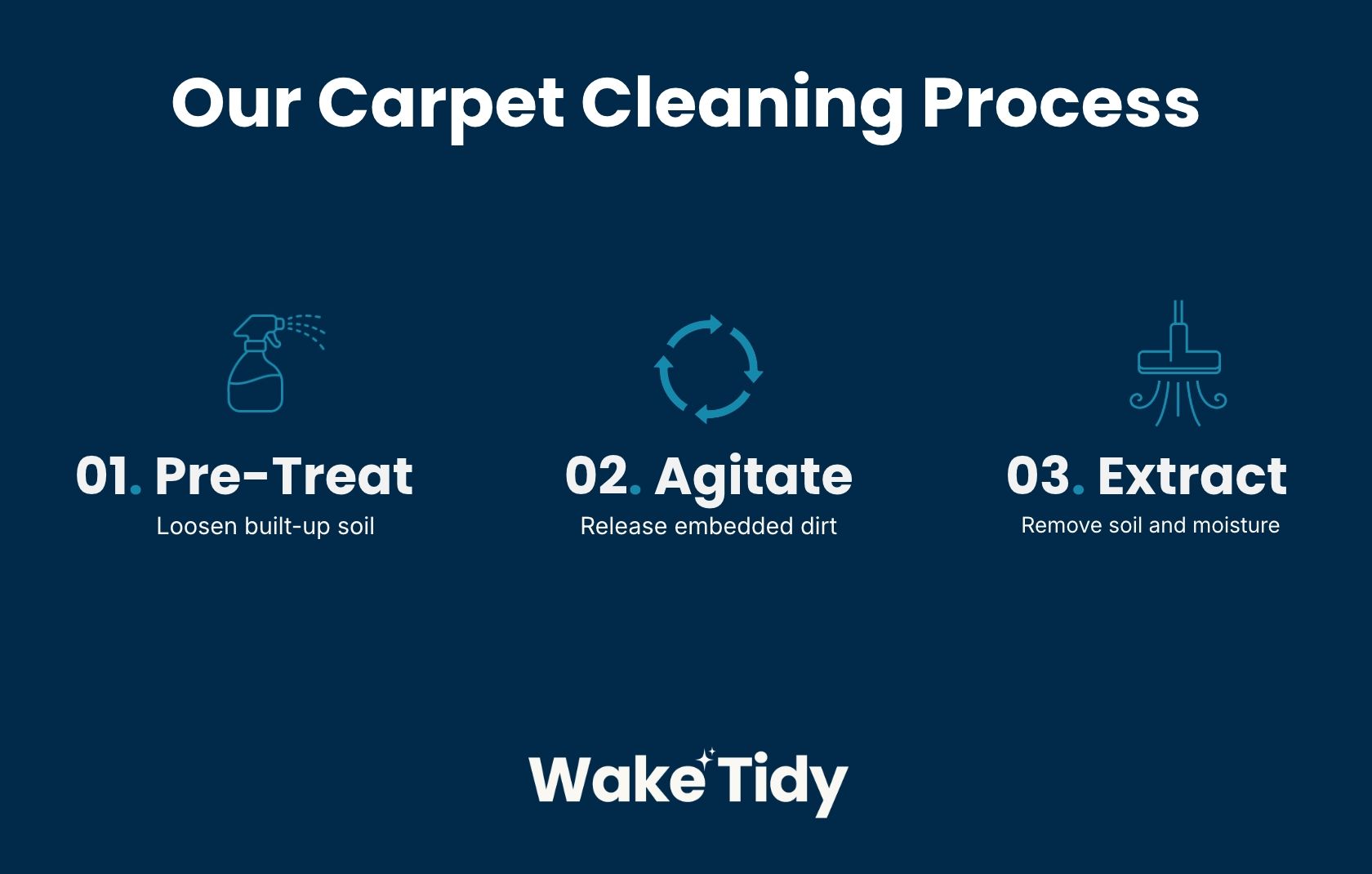
At Wake Tidy, our general approach follows three important steps:

1. Pre-Treat the Carpet
Before deep cleaning, the carpet is assessed to identify heavily soiled areas, traffic lanes, and individual spots.
An appropriate pre-treatment solution may then be applied to help loosen dirt, grease, and other buildup.
This step is especially important in restaurant dining rooms, where food spills and tracked-in grease can make carpets difficult to clean.
The solution needs to be appropriate for the carpet's fibre type and manufacturer recommendations.
2. Agitate the Carpet Fibres
Depending on the carpet and its condition, suitable agitation equipment can help work the pre-treatment into the fibres and release embedded soil.
For heavily used carpets, this can make a meaningful difference compared with simply applying cleaning solution and immediately extracting it.
The equipment and level of agitation have to suit the carpet. Some fibres and constructions require gentler treatment than others.
3. Extract the Dirt and Cleaning Solution
Once the dirt has been loosened, professional extraction equipment can remove soil, cleaning solution, and moisture from the carpet.
The quality of this step matters.
The objective isn't to soak the carpet. It's to clean it thoroughly while controlling how much moisture remains afterward.
Additional extraction passes, appropriate ventilation, and air movement may be needed to help the carpet dry.
Depending on the carpet type, soil level, and building requirements, a low-moisture cleaning method may also be appropriate.
Types of Commercial Carpet Cleaning Methods
Not every commercial carpet should be cleaned the same way.
A heavily soiled restaurant carpet may need a different approach from an office carpet that receives regular maintenance. A hotel corridor also has different scheduling requirements from a vacant commercial unit.
Understanding the common cleaning methods makes it easier to ask the right questions when getting a quote.
Hot Water Extraction (Steam Cleaning)
Hot water extraction is one of the most widely used methods for deep cleaning carpets.
You'll often hear it called steam cleaning, although the process primarily uses heated water and extraction rather than steam alone.
Cleaning solution and water are applied to the carpet, and professional equipment extracts the loosened dirt and moisture.
It's often a good option for removing accumulated soil from commercial carpets, provided the carpet manufacturer permits the method.
Hot water extraction can be especially useful for carpets with noticeable traffic lanes or significant dirt buildup.
However, the results depend on proper pre-treatment, equipment, technique, and moisture recovery.
Low-Moisture or Encapsulation Cleaning
Low-moisture cleaning uses specialized products and equipment to clean carpets while introducing less water than conventional extraction.
One common approach is encapsulation cleaning, where a cleaning solution is worked into the carpet and the resulting residue and soil are removed through subsequent vacuuming.
This method can be useful for ongoing appearance maintenance in offices, hotel corridors, and other busy commercial spaces.
Because less moisture is introduced, carpets may be ready for use sooner, depending on conditions.
However, low-moisture cleaning isn't automatically a replacement for periodic deep extraction, particularly when soil has accumulated deeper in the carpet.
Bonnet Cleaning
Bonnet cleaning uses a machine fitted with an absorbent pad to clean the upper portion of the carpet pile.
It can provide a quick improvement to the appearance of some commercial carpets.
However, it primarily addresses surface-level soil, so it isn't necessarily the best choice for carpets with deeply embedded dirt.
Carpet Shampooing
Traditional carpet shampooing uses cleaning solution and mechanical action to loosen soil.
Depending on the system, the loosened dirt and cleaning product are then removed through extraction or vacuuming after drying.
The main consideration is making sure cleaning-product residue isn't left behind, since residue can contribute to faster resoiling.
Which Method Is Best?
There isn't one cleaning method that's best for every commercial carpet.
For heavily soiled carpets, properly performed hot water extraction is often an appropriate choice.
For ongoing maintenance in high-traffic commercial spaces, low-moisture methods may be useful between deeper cleans.
The right choice depends on the carpet construction, manufacturer guidance, amount and type of soil, drying requirements, and access to the building.
A good cleaning company should be able to explain why it's recommending a particular method.
Truck-Mounted vs. Portable Carpet Cleaning Equipment

When researching commercial carpet cleaning in Kelowna, you'll likely come across two common types of extraction equipment: truck-mounted systems and portable carpet cleaners.
Both have their place.
Truck-Mounted Carpet Cleaning
Truck-mounted systems are installed in a vehicle, with hoses running from the machine into the building.
Depending on the equipment, they can provide substantial heat, water pressure, airflow, and extraction capability.
This makes them useful for many commercial carpet cleaning projects, especially when the building can be accessed easily from the vehicle.
However, the distance between the vehicle and the cleaning area, hose configuration, and building access all need to be considered.
Portable Carpet Cleaning Machines
Portable professional extractors are brought directly into the building.
They're often useful in locations where a truck-mounted unit can't easily reach, such as upper floors, certain hotel areas, secured buildings, or strata properties with difficult parking access.
Professional portable equipment is not the same as a small consumer carpet cleaning machine.
Some commercial-grade portable extractors can deliver effective cleaning and moisture recovery when properly matched to the job.
Does a Truck-Mounted Machine Always Do a Better Job?
Not necessarily.
A powerful truck-mounted system can offer advantages, but equipment alone doesn't determine the result.
The carpet's condition, pre-treatment, cleaning technique, extraction passes, and technician's experience all matter.
A poorly performed cleaning with powerful equipment can leave disappointing results. A properly performed cleaning with suitable portable equipment may produce a better outcome.
The important question isn't simply whether the machine is in a truck.
It's whether the equipment and cleaning process are appropriate for your carpet and building.
How Long Do Commercial Carpets Take to Dry?
For many business owners, drying time is just as important as the cleaning itself.
You don't want to have your restaurant carpets cleaned overnight only to open the next morning and discover they're still damp.
The same applies to offices, hotel corridors, and strata properties where people need to walk through the space.
Drying time depends on several factors:
- The amount of moisture introduced during cleaning
- How effectively the equipment extracts that moisture
- The type and thickness of carpet
- Indoor humidity and temperature
- Ventilation and airflow
- The cleaning method used
With the right equipment, technique, and drying conditions, some carpets can dry within several hours.
Others may take longer.
Why Moisture Extraction Matters
More water doesn't necessarily mean a better clean.
If too much moisture is left behind, drying takes longer and can contribute to unpleasant odours or other moisture-related problems.
That's why proper extraction is important.
A professional should consider how the carpet will dry, not just how it looks immediately after cleaning.
Dry extraction passes, ventilation, appropriate air movers, and reasonable scheduling can all help reduce the time the carpet stays damp.
The Morning-After Test
Imagine booking carpet cleaning for your restaurant after closing.
You arrive the next morning to prepare for service. The dining room looks cleaner, but the carpet is still damp and there's a musty smell.
That's not the outcome you wanted.
At Wake Tidy, we believe cleaning should be planned around how your business actually operates.
That includes discussing access, the cleaning method, expected drying conditions, and when the space needs to be back in use.
The goal is a cleaner carpet that's ready for your business, not a new problem waiting for you the next morning.
Commercial Carpet Cleaning for Different Types of Businesses

The type of business makes a significant difference in how carpets should be maintained.
Restaurant Carpet Cleaning in Kelowna
Restaurant carpets take a beating.
Constant foot traffic, food spills, drinks, grease, and chairs moving across the same areas night after night all contribute to visible wear and soiling.
One of the biggest trouble spots is underneath and around dining tables.
If tables are rarely moved during routine cleaning, dirt can accumulate around their bases and along the usual walking paths.
Restaurant carpet cleaning may involve:
- Pre-treatment of greasy and heavily soiled areas
- Attention to food and beverage stains
- Deep cleaning of traffic lanes
- Cleaning around and underneath movable furniture
- Work scheduled around closing and opening times
- Periodic maintenance for heavily used dining areas
For restaurants, scheduling is particularly important.
Cleaning needs to work around service, deliveries, staff access, and the next day's opening, Learn more about our restaurant cleaning services.
Hotel Carpet Cleaning
Hotels have several different carpeted environments, and they don't all experience the same conditions.
Lobby carpets receive outdoor dirt and concentrated foot traffic. Corridors experience repeated movement from guests, staff, and luggage. Meeting spaces may experience occasional heavy use.
A hotel maintenance plan might involve periodic deep cleaning of high-traffic areas, interim cleaning where appropriate, and scheduling that minimizes disruption to guests.
Depending on the property, cleaning may need to be coordinated in sections so that access remains available.
Office Carpet Cleaning
Office carpets can gradually develop dark traffic lanes near entrances, reception desks, workstations, and shared spaces.
Coffee spills, tracked-in dirt, and repeated use of the same corridors are common problems.
Regular vacuuming and prompt spot treatment help maintain the carpet between professional cleanings.
Commercial carpet cleaning can be scheduled outside normal office hours to reduce interruption to employees and visitors.
For offices with substantial carpeted areas, a combination of periodic deep cleaning and targeted attention to high-traffic zones may make sense.
Strata Carpet Cleaning: Hallways, Stairwells & Common Areas
Strata buildings present a different challenge.
Residents use the hallways and entrances every day, and it's difficult to completely close off common areas for cleaning.
Stairwells, elevator entrances, corridors, and lobby areas may all require special attention.
Access to upper floors can also influence equipment selection.
Portable equipment may be more practical in some buildings, while truck-mounted systems may work well where access permits.
For property managers, it helps to have a clear cleaning scope, realistic drying expectations, and a schedule that accounts for residents moving through the building.
How Often Should Commercial Carpets Be Professionally Cleaned?
There's no single schedule that works for every building.
A small professional office with limited traffic won't need the same cleaning frequency as a busy restaurant entrance or hotel lobby.
Carpet manufacturers often recommend different maintenance schedules based on traffic levels and soil conditions.
As a practical starting point:
AreaGeneral Deep Cleaning Starting PointLow-traffic private officesAbout once per yearShared offices and moderately used corridorsAbout every 6 monthsBusy entrances, waiting rooms, and main hallwaysAbout every 3 monthsVery heavily used restaurant and food-service areasPotentially monthly, with interim maintenance as needed
These are general planning examples, not universal requirements. Actual schedules should follow the carpet manufacturer's guidance and the conditions in the building.
The busiest areas may need more frequent attention than the rest of the floor.
In Kelowna, seasonal dirt and moisture tracked through entrances can also influence how quickly carpeted areas become soiled.
Rather than waiting for the entire carpet to look dirty, the better approach is to monitor traffic lanes, entrances, and common spill areas.
Can Old, Heavily Soiled Commercial Carpet Be Restored?
Sometimes, yes.
A carpet that's 15 or even 20 years old may still respond well to professional cleaning if the fibres and backing remain in reasonable condition.
But age alone doesn't tell the whole story.
There's an important difference between dirt and permanent wear.
Embedded soil may be removable.
Crushed fibres, permanent staining, fading, damaged seams, and deteriorating carpet backing are different problems.
Professional cleaning cannot reverse every kind of damage.
What to Look for Before Replacing Your Carpet
Before assuming replacement is necessary, take a closer look at:
- Whether the dark areas are mainly concentrated along walking paths
- Whether the carpet under furniture is noticeably cleaner
- Whether the fibres are worn down or merely soiled
- Whether stains appear permanent
- Whether there is visible damage to the backing or seams
- Whether previous cleaning attempts have improved the appearance
An inspection and small test clean may help establish what's achievable.
If cleaning can improve the appearance enough to meet your expectations, it may be worth considering before replacement.
If the carpet is structurally damaged or permanently worn, replacing it may be the more sensible decision.
At Wake Tidy, we'd rather explain what we think can realistically be improved than promise to make a damaged carpet look new.
How Much Does Commercial Carpet Cleaning Cost in Kelowna?
Commercial carpet cleaning prices vary depending on the property, carpet condition, cleaning method, and size of the job.
Some companies charge by the square foot. Others provide project-based quotes after assessing the carpet.
One Kelowna-area provider has publicly advertised commercial carpet cleaning rates starting around $0.15 per square foot, with other published rates reaching approximately $0.35 per square foot. Those are examples of advertised rates, not a standard industry price or a Wake Tidy quote, if you would like a detailed accurate quote for your commercial space, request a quote and one of our cleaning technicians will be in touch to assist.
A heavily soiled restaurant dining room may require considerably more preparation and detailed cleaning than a lightly used office.
Several factors influence pricing:
- Carpeted square footage: Larger open areas may be more efficient to clean than small or difficult-to-access spaces.
- Carpet condition: Heavy staining, grease, and embedded dirt can require additional work.
- Furniture: Moving tables, chairs, and other items affects the time required.
- Cleaning method: Different equipment and procedures have different costs.
- Building access: Stairs, elevators, parking, and hose access may affect the job.
- Scheduling: After-hours cleaning and restricted access windows may influence pricing.
- Frequency: A regularly maintained carpet may require less intensive work than one that's gone years without a deep clean.
The best way to get a meaningful price is to have the cleaning area and condition assessed.
At Wake Tidy, we prefer to understand what you're dealing with before recommending a cleaning approach.
That way, the proposed work reflects the actual condition of your carpets rather than relying on a price that doesn't account for the job.
One-Time Carpet Cleaning or Scheduled Maintenance?
You don't need a recurring janitorial agreement to arrange commercial carpet cleaning through Wake Tidy.
Some businesses contact us because their carpets need a substantial one-time clean.
Others want a regular maintenance schedule to keep high-traffic areas from reaching that point.
For a restaurant, periodic carpet cleaning might be coordinated with other deep-cleaning work.
For an office, it could be scheduled around quieter business periods.
For a strata property, it might involve hallways, common areas, and multiple buildings.
A practical maintenance program starts with understanding the carpet and how the space is used.
The goal is to prevent avoidable buildup while keeping the schedule manageable for the business.
Beyond Carpet Cleaning: Commercial Floor Care
Carpets are only one part of maintaining a commercial property.
Many businesses have a combination of carpet, tile, vinyl, and other hard flooring.
In a restaurant, you might have carpet in the dining room, tile in the washrooms, and hard flooring in the kitchen or service areas.
At Wake Tidy, we can also help with commercial floor care, including:
- Commercial tile and hard-floor cleaning
- Deep floor scrubbing
- Stripping and waxing suitable floor surfaces
- Periodic floor maintenance
- Other specialty floor cleaning needs based on the surface
Not every flooring material should be treated the same way.
For example, stripping and waxing is appropriate for certain resilient floor finishes, not every tile or hard-floor surface.
We'll look at the type of flooring and recommend an approach suited to the material and its condition.
Where a project requires specialty equipment or expertise, work may be coordinated with qualified cleaning specialists.
Our aim is to make it easier to manage the cleaning needs of your property through one point of contact.
Frequently Asked Questions About Commercial Carpet Cleaning in Kelowna
How much does it cost to have commercial carpets cleaned in Kelowna?
Pricing depends on the carpeted area, condition, cleaning method, access, and amount of furniture that needs to be moved.
Some local providers advertise square-foot pricing, but heavily soiled carpets, stairwells, and after-hours projects may be quoted differently.
A site assessment is the most reliable way to determine the scope and price.
How often should commercial carpets be cleaned?
It depends on foot traffic and the type of business.
Low-traffic offices may only need professional deep cleaning around once a year. Busy hallways, restaurant dining rooms, and entrances can require cleaning several times a year or more.
Regular vacuuming, prompt spot cleaning, and periodic professional maintenance all play a role.
What is the best method for cleaning commercial carpets?
Hot water extraction is often an appropriate choice for removing embedded soil from commercial carpets.
Low-moisture cleaning can also be useful for maintaining appearance between deeper cleans, especially where quicker drying is important.
The best choice depends on the carpet material, soil level, manufacturer recommendations, and building requirements.
Can 20-year-old carpet be cleaned?
Yes, many older carpets can still be professionally cleaned.
Whether they improve significantly depends on their condition.
Accumulated dirt may be removable, but permanent wear, fading, damage, and some stains cannot be reversed.
An assessment or test clean can help determine whether cleaning is worthwhile.
What is the best method to clean carpets?
For general deep cleaning, hot water extraction is a commonly recommended method when suitable for the carpet.
For routine commercial maintenance, low-moisture methods may also have a place.
The most effective approach combines regular vacuuming, prompt spill treatment, appropriate periodic cleaning, and proper drying.
How long will commercial carpets take to dry?
Drying times vary with the equipment, cleaning method, carpet construction, temperature, humidity, and airflow.
Some carpets may dry within a few hours under suitable conditions. Others take longer.
It's important to discuss drying requirements before scheduling a job, particularly when the business needs to reopen the following morning.
Is truck-mounted carpet cleaning better than portable carpet cleaning?
Truck-mounted equipment can provide substantial cleaning and extraction capability, but professional portable machines can also be effective.
Building access, carpet condition, equipment specifications, and technician technique all affect the result.
The appropriate machine is the one that can clean the carpet effectively while managing moisture and access constraints.
Can professional cleaning remove dark traffic lanes?
If the dark appearance is caused mainly by accumulated soil, professional cleaning may improve it considerably.
If the carpet fibres have become permanently worn or damaged, some discolouration or texture differences may remain.
A test clean can help distinguish between removable soil and permanent wear.
Does Wake Tidy clean restaurant, office, hotel, and strata carpets?
Yes. Wake Tidy provides commercial carpet cleaning for restaurants, offices, hotels, strata common areas, and other commercial properties.
Projects may be completed by Wake Tidy personnel or coordinated with qualified specialists, depending on the equipment and work required.
Does Wake Tidy also clean tile and other commercial floors?
Yes. Wake Tidy can help with suitable tile and hard-floor cleaning, deep scrubbing, and stripping and waxing where appropriate for the surface.
Carpet cleaning can also be coordinated with other periodic commercial cleaning services.
Need Commercial Carpet Cleaning in Kelowna?
If your restaurant carpets have developed dark walkways, your office is looking tired, or your strata hallways haven't had a proper deep clean in years, we'd be happy to take a look.
You might be surprised by how much difference the right cleaning process can make.
At Wake Tidy, we'll assess your carpet, discuss the condition and your expectations, and recommend an approach that makes sense for your property.
We can help with one-time deep cleaning, scheduled carpet maintenance, and other commercial floor cleaning needs.
Tell us what you're dealing with, and we'll help you figure out the next step.